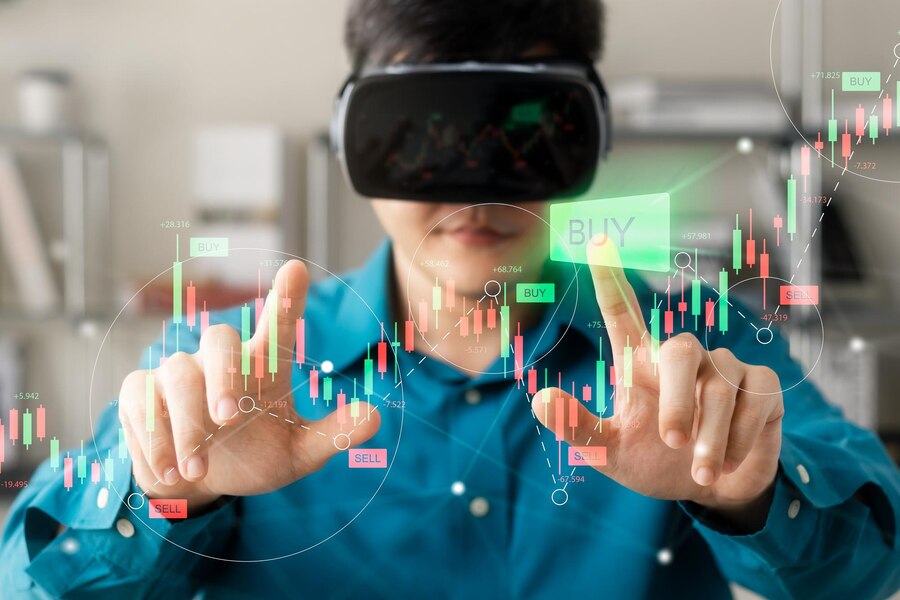
Sarah Martinez is a Miami based professional trader who recently doubled her monthly returns due to the shift towards a virtual reality forex trading platform. Rather than having to be positioned in front of several monitors 12 hours a day, she now engulfs herself in a 360 degree trading world where the currency market seems to be submerging around her in a digital musical symphony. It is no longer called science fiction; it is the new reality of virtual reality forex trading in 2025.
The incorporation of VR and AR technologies in forex markets has gained particular speed this year. These tools that were once being applied by tech-savvy traders experimentally have become mass trading solutions that are transforming the manner with which we engage on currency data.
The Reason Why VR and AR are Transforming the Forex Industry
In traditional forex business, traders are restricted to flat monitors and displays. Virtual reality forex trading does this altogether. Now traders are able to track movements in markets in space and get a three-dimensional view of the markets, create images representing information managed through hand gestures, and co-ordinate activities with partners in virtual trading floors.
The technology answers a basic issue that is information overload. Forex traders will normally use 6-8 screens at a time but in VR, you can multi-screen and access tens of streams of data with no limits. This increased capacity has the direct relationship in better trading decision and an increase in profitability.
AR is the addition to VR that has been used to place real-time market information on top of physical environments. When traders are on the move throughout the day they are able to get instant alert on currency changes hence constantly able to monitor market without being tied down on charging trading terminals.
Present VR and AR Solutions Trying to Change Forex Markets
Engaging Trading Spaces
Top VR platforms currently provide virtual trading floors that are fully realized wherein participants are allowed to interact with live market information in real time. They are modeled on the traditional trading floors but offer a greater functional capacity beyond the physical world.
One of the breakthrough platforms that are catching on among professional traders is D6 VR which is developed by Andy Maggio, former Morgan Stanley analyst. The system enables traders to manipulate several data streams in real-time and have spatial awareness of the relationship between them in the market.
The augmented reality system offered by FlexTrade includes optimal market data which is overlaid into the real world environment thus allowing traders to be situational aware by providing them access to key trading knowledge. Such a hybrid solution is especially useful to traders who require mobility without losing their connection in the market.
More Data Visualization
VR revolutionizes ordinary charts and graphs to allow the user to interact with them in a 3D environment. Traders are allowed to zoom on a particular information point, distort charts live, and overlay many indicators to get a detailed analysis. It allows seeking out patterns and trends that were not seen in two-dimensional representations under this increased capacity of visualizing.
The technology also allows incorporating artificial intelligence and machine learning algorithms. The AI-enabled applications allowed in VR settings are capable of detecting trading opportunities, forecasting market trends, and making decisions regarding risk management, better than traditional resources.
Training and Education Revolution
VR opens possibilities in learning and honing forex skills like never before. Setting newcomers: it is possible to practice in a simulated environment (mimicking real market conditions) without risking real capital since novice traders will only get to play with virtual money. These practice plans provide secure, but realistic training environments, which induce confidence prior to going live in the trading world.
Trading companies and schools are developing interactive learning units in the VR world. The learning process allows students to interact with trainers, simulate live simulations and engage peers in ways which could never be imagined with traditional learning practice.
Everything That Makes Virtual Reality Forex Trading Best in 2025?
No Shortage of Screen Real Estate
Physical trading systems limit traders to a number of finite monitor arrangements. VR removes all these limitations. Traders are free to show the number of data streams, graphs, and analyst goods in their virtual work environment. This increase significantly enhances processing speed of information and rate of decision making.
Spatial Data Relationships
In three-dimensional settings, traders can make a better comprehension of relationships among various different currency pairs and market conditions more intuitively. Rather than toggling between distinct charts, traders are able to use graphical representations to visualize relevance and connection in space, suspending to make more effective strategic choices.
Dissuaded Physical Stress
Long working hours usually lead to the tension of the eyes as well as neck pains and repetitive strain injuries due to the use of a monitor. VR space would minimize these physical demands because they will be able to perform natural movements of the head and body yet they have access to trade information.
Team Work Advantages
Virtual trading floors will allow international cooperation even when not in the same location. Distinct continent traders can have common virtual workspace, give mutual insights in real-time and devise their plans as though sitting adjacent to one another.
Real Byway: Sampling the VR Forex Trading
Hardware Requirements
The basic VR forex trading necessitates a competent headset and computer system. Common are Meta Quest Pro, HTC Vive Pro, and more dedicated trading use cases. The 2025 resolution improvements are twice that of the past generations, so text and data visualization is far more discernible.
Software Platforms
Various exchanges have currently provided VR-compatible interfaces of trading. They include established brokers who afford themselves VR, and independent VR-first trading platforms that are dedicated to offering immersive trading experiences.
Cost Considerations
The cost of initial VR set-up ranges between 500 dollars and 5000+ dollars on high-end professional systems. Nonetheless, these investments pay off through productivity enhancements in a matter of months in the case of active traders.
2025 in Real Life
VR implementation results in a large increase in productivity reported by professional trading firms. Hedge funds report 23 and 31 percent improvements in trade execution speed and decreased time spent in analysis after key traders have been switched to VR solutions.
Even individual traders confirm improved performances. In addition to the story of Sarah, other traders report enhanced pattern detection, less decision fatigue, and risk management using VR tools.
Challenges and Limitations to Wrestle With
Physical Comfort
Long exposure to VR may lead to physical discomfort and cognitive vertigo among users. The majority of the platforms suggest using continuous use no more than 2-3 hours and taking a break during the sessions.
Technology Learning Curve
Investment of time and training is also needed to shift traditional trading interfaces to modern ones. Gesture-based controls and spatial navigation can present problems to some traders in the beginning.
Market Adoption Rate
During the period of its fierce expansion, VR trading still has a niche compared to classical platforms. Such slow uptake has the potential to curtail collaborative engagements and the means to develop the platform.
Future Perspective: Where VR Forex Trading Is Going Next
The forecast in the industry indicates that the global virtual reality (VR) market has a prospect of $339.29 billion by 2033, and financial applications are projected to exceed remarkable growth. One of the growth segments in this growth is forex trading.
The technology of 5G will allow achieving more advanced VR experiences in terms of shorter latency and better data transfer. It will promote much smoother and adjustable trading in real-time.
The process of implementing AI is still moving forward, and by 2025, even more advanced predictive analytics and closed automated trading support in VR will be available. These will go a step further to increase the ability of the trader and the accuracy in market analysis.
The Importance of a Transition: Things to Remember
Traders interested in the implementation of VR ought to begin by using test-platforms and progressive deployment. It can be tested at VR brokers in the demo without having to invest too much.
Seek first to implement specific use cases as opposed to wholesale replacement of the platform. VR is more successful at data analysis, pattern recognition, and collaborative planning, so it is best not to start with these.
Have backup old trading access options in the transition periods. Though the reliability of technology is increasing, it cannot be fully relied upon in ensuring that there are no contingency plans to overcome critical trading conditions.
Summary: Voluntary Virtual Trading Revolution
Virtual reality forex trading is not just a matter of technological advancements, it is a kind of paradigm change towards a more natural, efficient and cooperative way of trading. The success tales that abound during 2025 have proved to have actual competitive advantages to the early adopter.
The technology not only solves real-life shortcomings of traditional trading interfaces, but it also opens up new opportunities that used to sound unbelievable a few years ago. VR trading can be expected to be the norm in charts of forex trading as opposed to the bleeding-edge as the hardware increases efficiency and price falls.
To traders who have time to acquire new demands and interfaces and work processes, VR can bring significant benefits to data processing, pattern detection, and shared analysis. It is not a question of whether VR might change the face of forex trading, but of how soon traders will be able to embrace these amazing new technologies to their own advantage.
The currency trading of the future is arriving today. It so happens that it is virtual.