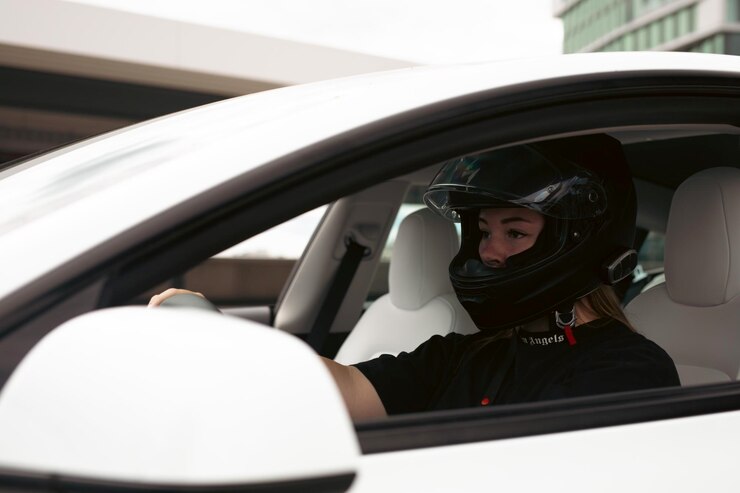
The rumble sound of a sports car engine used to give ultimate speed with little consideration given to what happened when things went wrong. Back in the 60s, when people were riding dune buggies, drivers buckled themselves in with machines designed for speed – not safety. Fast forward to 2025 and the landscape is completely changed. Today’s sports cars have much more safety than a spacecraft-including artificial intelligence that can predict crashes ahead of time.
This spectacular turnaround did not happen overnight. It took decades and thousands of auto racing deaths, advances in engineering and government enforcement to make sports cars the safer marvels they are today. How performance and safety started living together again – from simple rollbars to AI-based protection systems.
The Dark Ages of Sports Car Auto Racing: Early Modern Times
Condition of early racing cars was essentially a death trap in attractive sheet metal. Creatures man, ingrained in tight cockpit spaces with feet gripping along out beyond the front axle stripped of defense by little more than a leather helmet and prayers. When accidents happened, many times they were deadly.
In the very beginning of the motorsport, a Britishman who witnessed a terrible number of accidents, John Aley, an Englishman recalled the necessity for a device protecting what is very important so John went to implement the device – the first rollbar that became a standard in the motorsport. His was a simple but radical innovation. In order to be structurally safe, an added layer of support was attached in the form of a stiffened metallic bar behind the driver’s seat and it is available in every car for safeguarding purposes in case of rollover. When, in 1971 after a steady increase in the death rate on the race-track, racing deaths started to attract the attention of the Federation Internationale de l’Automobile racing teams, the FIA finally required that all race cars be equipped with rollbars. This was the start of the evolutionary process for the safety of the sports car which would go on to save thousands of lives.
The Porsche 917, a brutal 250mph beast of the late 60s, showed how primitive the safety level is on the most advanced level. The tube-frame chassis cars provided little protection in medical emergencies, but pilots raced them during 24-hour endurance trials at all hours under dark and rain conditions. The risks were monstrous even by modern standards, but the courage necessary for it was impressive.
Building a Protective Shell
Give priority to energy absorption per se rather than rollover avoidance. Mercedes-Benz was the first major automobile to use the idea of a crumple zone, doing so with their 220 model in 1959. These engineered zones would deform in a controlled way under impact and absorb the kinetic energy before it gets to the passenger compartment. The technology was imperative on sports cars traveling at higher speeds.
Three-point belt ridden dem out Hunter safety pioneer Nils Bohlin Services andachtet in 1958. Newer forms of deployable pretensioners to immediately tighten the belt in their forks and old-school load limiters to reduce belt-based injuries have emerged into the sports car that would beat you to death. These systems work with several strategically placed airbags throughout the cabin. Gone are the days of frontal single airbags; side curtains, knee and thorax airbags work within milliseconds of an accident nowadays in sports car.
The McLaren 650S embodies how we are building supercars today, combining safety and performance in an optimized designed car. Its carbon fiber Monocell chassis is significantly lighter than standard steel chassis frames yet delivers tremendous rigidity and protection against impact. The inherent strength of the structure is very high and yet the lightweight construction effectively absorbs the energy away from the occupants during collisions. This is a quantum step further along the line from the balsa-like buildings of old sports cars.
When Cars Started Thinking
Active safety systems constituted the next quantum leap for the safety of sports cars. So, whereas such technologies serve to protect occupants in case of an accident, these technologies are all geared towards preventing the accident from occurring. The Advanced Driver Assistance Systems, better known as ADAS, were the market between passive protection and full autonomy.
Some 78% of automotive manufacturers measure in the automotive industry have already consider some kind of AI in their process, up considerably from only 62% two years ago. Modern sports cars are available with completely adaptive technically advanced cruise control, comfortable following distance, automatic centring and curve compensation of the vehicle and also automatic intersection monitoring of the traffic. These systems process information from the sensors in real time, looking for potential danger situations, faster than a human would react.
Porsche is the standard-bearer of how effectively these technologies work in luxury sports cars. The 2025 Porsche 911 will have fatigue detection based on eye movements and driving style. As soon as the system detects drowsiness it will alert the driver. Lane Keep Assist (LKA) LKA is a camera based system that uses cameras to monitor the road lane and push the vehicle back into center if it wanders off the road line. Traffic Sign Recognition, which establishes speed limits and road conditions and presents them directly in the instrument cluster
Vehicles with full ADAS packages reduce accident rates by 35% to 40% compared with identical models that do not have comprehensive ADAS packages installed. But that’s not a marginal improvement. That’s the difference between a fender bender and a trip to the emergency room, or between a near miss and a disaster.
The AI Movement in Sports Cars
Artificial intelligence is the leading edge of sporting automotive safety for the year 2025. These systems are pains above abstentiousness; they prophesy, think, and as ways to act thusly to driving conditions with frightening refinement.
Safety cameras now have a 360-degree view of the vehicle and are using AI to detect hazards in real time using machine learning. The technology is not only cognizant of obstacles, but also of context. Does that pedestrian look like she is about to enter the road? does the vehicle in front brake suddenly? These scenarios are read immediately by AI and appropriate action is taken.
Driver monitoring systems use AI cameras and sensors within the car, which track activities in the cabin, such as how one treats a vehicle. These systems check for drowsiness, distraction, and impairment by monitoring head position, eye movement and steering inputs. As soon as the car finds it is taking risky turns, it gives warnings. In advanced instances, there are some vehicles that can even spontaneously slow down or have hazard lights on without any kind of driver intervention. This technology is designed to eliminate the vast majority of accidents caused by human error which is responsible for the vast majority of collisions.
Predictive maintenance driven by AI tracks thousands of vehicle parameters all the time. For sports cars taken to their performance limits, this capability is invaluable. The system detects new mechanical behavior before it leads to failure, meaning there could be catastrophic brake failures or tire blasts at high speeds could be avoided. Commercial fleets with this technology installed in late 2024 will achieve first-year savings of more than $4.5 million across 500 vehicles, which is a return on investment over 400%
Official Statistics Aren’t Everything
How do these technologies work when rubber meets road? The results speak volumes. Safety systems with a synthetic intelligence layer have already proven to reduce crash rates by up to 40% in the real world. Automatic emergency braking in isolation reduces rear-end crashes by some 50%. For a sporty car E.which can reach triple values digital, one can make from these statistics a direct calculation on the saved lives.
The Ford Mustang is returning to its place towards the high safest sports cars list for 2025, securing an 8 out of 10 safety score from a nod of approval by both combined NHTSA and IIHS safety testing. How forceful entrenched muscle cars were historically substantially turned in with the safety of the occupants. High-end manufacturers such as Porsche, Ferrari, and McLaren have done the same, incorporating cutting-edge safety features without sacrificing the thrill of driving that is unique to sports cars.
The newest round of testing, Euro NCAP, considers our 2025 fleet and 14 of the 20 new models executed five-star ratings with ever-changing, stricter testing regulations. Tests now include collision avoidance with motor cyclists, night vision detection of pedestrians and driver monitoring needs. Traditionally not considered a sports car, the Tesla Model 3 deservedly scored highest overall at 359 out of 400 points while establishing new safety records across the industry.
What Comes Next
The speed of the sports car safety evolution is not slowing down. AI systems are becoming more intelligent using predictive analysis processes to evaluate risks before things get dangerous. Machine learning enables these systems to get even better over time, learning from several billion miles of driving data in order to adjust their reactions.
Biometric access systems are being used in sports cars where fingerprints or facial recognition are used to gain access to the vehicle. This provides greater security, while also making it possible to set individual safe driving limits based on the driver profile. Vehicle-to-everything (V2X) communications among sports cars will in the future allow them to share information about hazards around them with other vehicles and infrastructure in real time.
Future systems are likely to use more sophisticated forms of AI, which will be able to interpret complex traffic situations with near-human level decision making. The point is obvious: make driving a sports car as exciting as it ever was while virtually eliminating all the life-threatening risks that have previously been intrinsic to the sport.
The Bottom Line on Updaters & Updates
The evolution from rollbars to artificial intelligence has been one of the great engineering triumphs of all time in the automotive industry. Safety and protection: Plain and simple, sporty vehicles that used to be white knuckle rides of risk and trial now come fitted with thick layers of sophisticated protection technology that’s always working to keep occupants safe.
This sports car protection evolution evidences that performance and protection are never mutually exclusive. Today’s high-performance vehicles will provide lightning performance rates as well as extreme handling characteristics while also watching for threats, anticipating mechanical failures, and taking contingency action to keep occupants safe. The cars that were once the picture of danger have evolved into the models of safety technology that became standards that—which filter throughout the whole automotive industry.
For those aficionados for whom the visceral enjoyment of the sport car driving experience is infinitely precious, this evolution implies a crucial meaning for our lives. The board is just as much fun as ever but the effects of making a mistake or mechanical failure are minimised. That’s not progress, that’s a revolution to celebrate.