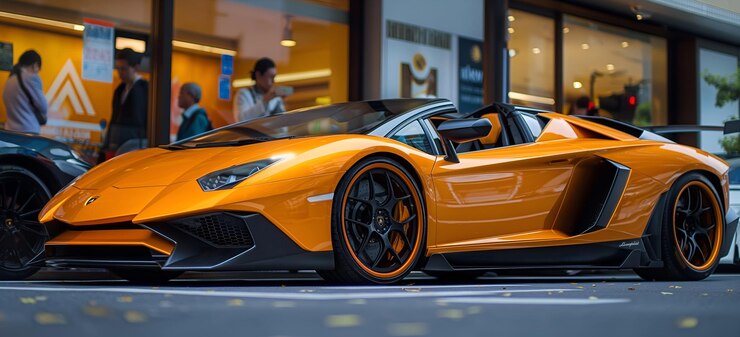
In the year 2025, the automotive world attained an extra-ordinary thing to witness. As the global markets became uncertain, the market in the supercar segment had exploded with spectacular demand with a mind-blowing USD 31.4 billion mass valuation. And the thing that surprised everyone though– it was not about raw horsepower anymore.
This year changed the picture of supercar entirely. Old giants were also challenged not only in the speed, but also in the sustainability, technology, and innovation at a hybrid point. The result? A total mix up of the leadership line.
Lamborghini Takes the lead.
Lamborghini became 2025 unchallenged victor with its record-breaking performance on the paper and sales numbers. Italian carmaker sold 5,681 super cars in the first 6 months of 2025 which is their top H1 performance and actually a 2 percent increase over 2024.
What is astonishing about this? According to the CEO Stephan Winkelmann, Lamborghini survived at a time when the whole world suffered economic and political instabilities. They had a model but it was not that alone. It was their total tactical turn to hybridization.
Sustainability of the brand narrative revolves around two major models. The Lamborghini Revuelto remained in their fine performance, and the new Urus SE hybrid SUV provoked the market interest. But the real game-changer? The long-awaited Temerario that completed Lamborghini undergoing the switch to the full hybrid line.
Temerario: The Hybrid Revolution.
Lamborghini temerario symbolizes the temperature magic of 2025 to the supercars. This successor to Huracin features a twin-turbocharged V8 with 3 axial-flux electric motors, and yields a combined power of 907 horsepower and 800 Newton-meters of torque.
It is in performance figures: the 0-100km/h in only 2.7 seconds and it can go up to 343km/h. However, the Temerario is more practical inside than the current model with getting heating and ventilated seats, and does not lose Lamborghini aggressive looks. It is the ideal case of balancing 2025 super cars between the performance and utility.
The Hybrid Takeover
What happened such that the year 2025 was the year of hybrid supercars? The market numbers indicate that hybrids and electric powertrains are already 35% of the supercar market and the number will increase in 2033 to 60%.
This change offered champions and confronted the old methods. Brands that, however, became early electrified entrained themselves. Those who didn’t? They scrambled to catch up.
Ferrari is Technological Masterpiece.
The F80 hypercar awarded F80 a first place position on a number of the most anticipated lists. Only 799 units were produced and costing around £3.1 million, the F80 displays 1200 horsepower by an intense 3 liter V6 blended from their winning 499P race car in Le Mans also.
These figures are humongous: 0-124mph takes 5.75 seconds and the top speed reaches a 217mph. Still, there is more to the F80 than speed. It is the harmony of the racing technology into a picnic-like road-legal car and it is the loudest customer road-car project of Ferrari.
McLaren Engineering Excellence.
In a bid to one-up the game, McLaren came up with the W1 hypercar to herein refer to the much awaited spiritual successor to the classic P1. The W1 uses a 4 liter twin-turbo V8 engine with electric assistance, with 1 256 horsepower and 1,340 Newton-meters of torque.
What makes the W1 special? It attains 0-100km/h in 2.7 seconds and moves with the top speed of 350km/h. The engineers of McLaren designed an effective downforce than any other former McLaren road car whilst the coefficient of drag stayed low, which was a breakthrough in aerodynamic efficiency.
American Muscle Goes Hybrid
A quick shock to the auto industry came when Chevrolet declared not a single, but two pioneering Corvettes in 2025. The ZR1 is the first production Corvette to have a turbocharging feature that produces 1,064 horsepower of its 5.5 liter of twin turbo V8.
But the real surprise? The first hybrid super car in America, Corvette Zora, is capable of making 1,224 horsepower on the power of the hybrid power train. It is the necessary change of the image of the sports car in America, which proves that even the most conservative manufacturers are becoming electrically charged.
Performance/Market and Global Reach.
The car market on the supercar 2025 was significantly strong in all the regions. International performance of Lamborghini can be large automobiles which serve as an example: 2,708 consistently sold in Europe, the Middle East and Africa; 1,732 in the Americas and 1,241 in the Asia Pacific.
This wasn’t just a geographic distribution that demonstrates that supercar enthusiasm does not exist solely in traditional markets. Emerging economies are playing a significant growth role and the overall market is expected to continue growing with the current rate of 8.5compound annual growth up to 2033.
What Drove These Numbers?
A number of drivers helped to fuel the boom in the 2025 supercar market:
Technology growth in engines: Hybrid technology presented the ideal balance in performance and environmental conscience. Customers may have an amazing leverage and may be more confident about the environmental effect.
Customization requirement: Buyers wanted unique and customized vehicles and manufactures have answered it. Ultra-personalization and custom services became one of the selling arguments, in particular on the German market.
The integration technology: Supercodes became more attractive to tech-savvy customers with their advanced driver assistance systems, features powered by AI, and connectivity-related concerns.
The Competition Is Induced.
It is possible to mention in 2025 other important steps of whom? Competitive environment was hotter than ever with the experienced and new entrants competing against each other.
On the one hand, just as the product undergoes development, Nissan created enormous hype with the GT-R R36, a successor to the iconic R35 GT-R that ceased production in 2024. Not much is known about it but the R36 should be hybrid powered, furthering the electrification direction.
The 911 GT3 RS Manthey Racing made Porsche hold its ground indicating that traditional internal combustion engines have their enthusiastic proponents. New Vantage and Vanquish models by Aston Martin have also attracted attention proving that the British engineering is still relevant in this era of super cars.
Looking Beyond 2025
The bright sky of supercars is shining with the many success stories of 2025. The adoption of hybrid technology in the market indicates that the coming few years will experience further advanced powertrains. The next gridel polyphase cars are still in front of us and various manufacturers already test their prototypes.
Customization will probably also be of greater significance. As the market becomes more competitive and gets bigger, manufacturers will have to provide an increasingly personal experience to be distinctive. The luxury customer with the means to buy supercars seeks exclusivity and brands are providing it.
Those who prevailed in the 2025 supercar market had to adapt and be creative instead of following convention and entrenchment. Lamborghini achieved such a record success due to the issue of change without losing sight of their original identity. Ferrari, McLaren and Chevrolet all managed to be successful as they dared to challenge technology without adhering to safety.
To car lovers, 2025 will have left a memory of how supercars developed into high-tech spectacles that just happen to run very fast. Those brands that noticed this change in its infancy were able to take the lead and those that failed to understand this shift early created a situation where they had to scramble to keep pace with an ever more competitive business environment.