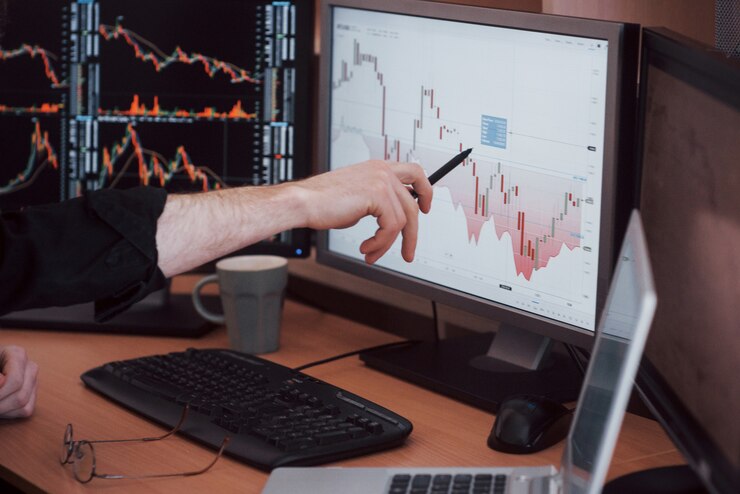
The daily trading volume of the forex market amounts to more than 7.5 trillion dollars yet behind the enormous figures, there is an underbelly that can bring even the seasoned traders to their knees. Market noise generates bogus signals capable of ruining trading accounts in a short time than a margin call.
How about an avenue to prune out this mess? DSP to reduce noise in the forex market has become an innovative breakthrough that is revolutionizing the way traders are dealing with the currency markets in 2025.
Market Noise in Forex Trading.
Market noise is the totality of the price information that misleads your perception of the underlying direction. Think of it as static on a radio station. You are aware that the music exists, but it is difficult to hear in case of interference.
This noise occurs in forex as minor adjustments and intra-day volatility that may lead to premature stop-losses or false trading signals. Random fluctuations will also occur even in the presence of a directional bias in a currency pair as large institutional positions enter and exit the interbank market.
The mental effect takes its toll on traders. This is caused by the constant exposure to noise in the market which builds up anxiety and stress resulting into a state of decision fatigue and impulsive trading behaviors. Most traders are left second guessing their tactics in situations when the immediate volatility clouds the way they are thinking.
What Is DSP in Forex?
Digital signal processing uses mathematical algorithms to evaluate and sift financial market data. These methods are long-established by large investment banks and hedge funds, which are trying to gain competitive advantages by using proprietary algorithms to identify price movements.
DSP considers price charts as audio signals that require Cleaning. Digital filters can also cancel market noise leaving the underlying information of the trend, just as noise-cancelling headphones can cancel the unwanted sound.
The essence of this is detecting a cyclic trend in price data. Conventional measures such as the use of simple moving averages and the Relative Strength Index already presuppose some cyclicality. This is something that DSP methods merely do better.
Core DSP Techniques for Noise Reduction
Moving Average Filters
Basic low-pass filters used to smoothen price data over a certain time are represented by the traditional moving averages. Nonetheless, digital filters are better in performance with a smaller lag and more responsive to underlying data changes.
A digital low-pass filter is used to follow price variation more closely than conventional simple moving averages. Such filters are perfect to capture the cycles with lower frequencies (longer-term trends), and noise with higher frequencies is not permitted through the filter.
High-Pass Filters
High-pass filters are opposite but focus on the short-term price changes and reduce the long-term trends. These come in handy especially in the formation of reversal patterns and turning points.
High-pass filter outputs are kept relatively small in trending markets since they aptly eliminate the prevailing low-frequency trend components. As trends are terminated, the filter output is more pronounced as it indicates possibilities of reversal.
Frequency Domain Analysis
The high-tech DSP methods are used to analyze forex data in the frequency domain where the price movements are decomposed to their constituent frequencies. This enables traders to isolate certain cyclical patterns and sift noise out.
Practical application of frequency domain analysis to forex trading is time series momentum and averaged time series momentum. These are used to determine long term directional movements with a minimum of signal errors.
Digital Signal Processing for Forex Market Noise Reduction: Practical Implementation
Step-by-Step Implementation Process
Data Preparation: Collect high-quality price data for your target currency pairs. DSP application relies on clean datasets.
Filter Selection: Select digital filters which fit your trading time and goals. Trend following strategies are best accomplished with low-pass filters and reversal strategies with high-pass filters.
Parameter Optimization: Use past data to experiment with the filter parameters in order to identify the best ones to use with your particular trading strategy.
Signal Validation: Aggregate several DSP methods to verify trading signals and minimize the false positives.
Modern AI Integration
Artificial intelligence has been used in 2025 to transform DSP applications in forex trading. Algorithms based on AI use a large volume of market data in real-time to determine high-probability trade structures in a way that is far quicker than conventional processes.
These systems offer the exact entry and exit points in addition to sifting through market noise to identify the best levels of trade. Over time, machine learning models are automatically adjusted to changing market conditions, which increases filter efficacy.
Advantages of DSP Noise Reduction Methods
Digital signal processing has a number of critical advantages over the conventional methods of noise reduction:
Less Lag: DSP filters will react to changes in price faster than simple moving averages. This enhanced responsiveness assists traders to get in and out at more advantageous prices.
Clarity of Signal: DSP methods offer a more precise trend detection and turning point awareness by eliminating non-relevant noise. Traders are able to concentrate on meaningful price changes but not random changes.
Parameters that are customizable: DSP filters can be tuned to specific market conditions, and certain trading styles, with exact parameters unlike fixed indicators.
Objective Analysis: The mathematical algorithms remove the emotional factor in the decisions of noise filtering. This objectivity comes in handy in such stressful market situations when psychological elements normally hinder judgment…. The DSP Methods versus Traditional Approach to Comparisons.
Chart pattern recognition and simple technical indicators are very important in traditional noise reduction. Renko, Heikin-Ashi and Kagi charts offer a more comfortable visualization of the trend but they are not as precise as mathematical filtering.
Moving averages and oscillators such as RSI are standard because they are programmed on fixed formulae that do not respond to the evolving conditions in the market. DSP methods, in their turn, can be adjusted to the currency-specific pairs and market-specificities.
The difference in responsiveness is very striking. It may be seen that where the traditional indicators may be several periods behind price action, the well tuned digital filters follow the underlying trends more closely and still retain the ability to suppress noise.
Real-World Applications and Case Studies
A research study in 2021 showed that a combination of the ARIMA and artificial neural network algorithms through digital processing models was successful in forex prediction. Owing to high performance, the model made few errors (0.7 percent) and quick processing time (26 seconds) during testing on 20 years of currency data across five major pairs.
The high frequency trading companies use DSP in decision making at the micro second level. These applications exploit short-term fluctuations in the market to make returns on small margins but on high volumes.
Signal processing uses proprietary trading techniques in professional hedge funds. These operations are secretive and this shows the competitive advantage that noise reduction offers.
Technical Implementation Considerations
Software and Tools
MATLAB is still popular in the trading application of DSP. It includes an extensive signal processing toolbox that offers filter design and implementation ready-to-use functions.
Libraries such as SciPy and NumPy are the best replacements of Python. These open-source applications bring DSP to the individual traders without costly software subscriptions.
DSP capabilities become more and more embedded in modern trading systems. A host of them now also provide customizable digital filters in addition to more traditional technical indicators.
Computing Requirements
Implementing real-time DSP needs sufficient processing power to handle currency pairs (particularly multiple currency pairs). The cloud computing solutions are able to do complex calculations without overpowering local hardware.
The memory management can be important when large historical data are processed to perform backtests and optimizations. Data structures aid in ensuring that the resources are minimized without compromising on calculation speed.
Common Challenges and Solutions
Over-Filtering Risk
Violent noise suppression may erase useful price messages and the undesired noise. The point is to identify the best filter parameters that will not remove trend signals but will remove irrelevant fluctuations.
The sweet spot between signal preservation and noise reduction can be determined by backtest of a variety of combinations of parameters. Frequent optimization will ensure that filters are efficient amid the changing market conditions.
Computational Complexity
Complex DSP can be more compute-intensive and thus may introduce a lag in trading decisions that are time sensitive. These limitations can be solved by simplified algorithms or cloud processing.
Filter values and effective coding practice can be pre-calculated to reduce the processing delays of live trading sessions.
Future Trends in DSP for Forex
Machine Learning Integration
The overlap between DSP and machine learning has been gaining momentum in 2025. The ability to reduce noise can be enhanced even further by adaptive filters which are sensitive to market behavior.
Filter parameters can be optimized automatically by neural networks, taking the brunt of the manual tuning process off traders. More complex noise reduction strategies can be realized using this automation without extra complexity.
Real-Time Processing Advances
DSP calculations that are more complex can be performed in real-time trading applications because of improved hardware and software capabilities. Edge computing moves the processing even further toward the data sources, further decreasing the latency.
Advances in quantum computing could one day transform DSP power, but it will be years before it is used in practice.
Conclusion: DSP to maximize Trading Success.
Digital signal processing of forex market noise reduction is a remarkable innovation as compared to conventional filtering approaches. Mathematical rigor to market analysis enables traders to gain clearer trend identification and more accurate entry/exit timing.
The key to success lies in proper implementation and continuous optimization. Simplify the methods of digital filters and then move to the advanced methods. Always check DSP signals with other analysis procedures to be reliable.
Due to the constant development of the forex markets, those traders who master such sophisticated noise reduction tools will remain a lot ahead of others, who adhere to the old methods only. The payoff of investment in learning the DSP concepts is reflected in increase trading accuracy and a decrease in false signals.