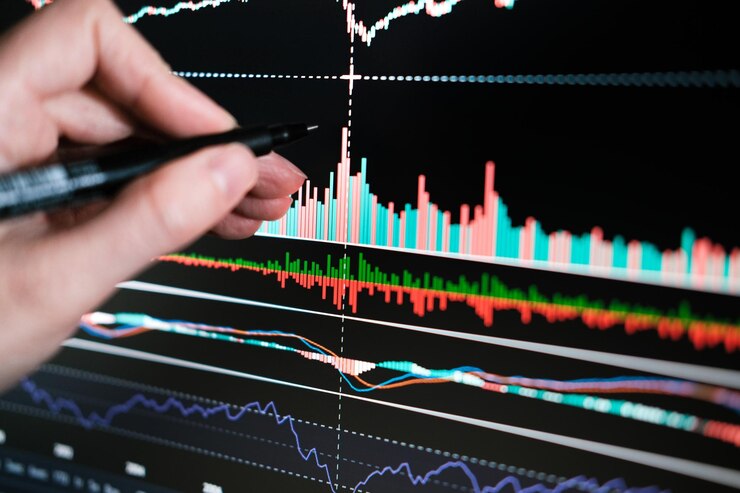
The high frequency forex trading is accelerating. Since markets change by the twinkle of a second the ability to predict the flow of prices in an instant is a means to profit. In 2025, deep learning models predicting high frequency forex are transforming the trading strategy. These models not only examine price patterns- they deduce complex patterns that are not visible to human traders. But what actually are these deep learning architectures transform forex markets? What makes them better than standard methods?
Deep Learning Models of High-Frequency Forex Prediction What?
There is the use of artificial neural networks in scale information processing of the human brain in the deep learning models. They apply vast amounts of data on forex markets including price tick, order book and even news sentiment to forecast currency movements on high-frequency intervals (in the millisecond-to-seconds range). The models also indicate the nonlinearity of the relationship in data as compared to the simple algorithms and are therefore able to adapt to the dynamically changing market conditions. Common architectures are the Long Short-Term Memory networks (LSTM), Convolutional Neural Networks (CNN), Transformers and Deep Reinforcement Learning systems.
The ability to process microstructure data, including bid-ask spreads, order flow, and market depth, which were once too complex to process in real-time has been provided due to such technological breakthrough. In fact, some models may be able to give accuracy prediction of medium-short term trends in forex markets which greatly improves trade execution.
Why Is Deep Learning Models More Effective in Forex?
The tools of historical forex prediction were likely to employ statistical analysis including ARIMA or naive machine learning tools, which could not keep up with the complexity and pace of data on the high frequency. Deep learning excels because it:
- Efficiency: High frequency data volume and velocity is processed efficiently.
- Adapts to new, real-time information quickly.
- Combines a wide range of data points: prices in the past, economic indicators, and the sentiment of social media.
- Obtains the intrinsic data patterns that are not evident and nonlinear.
- Dynamically optimizes trading strategies with the help of reinforcement learning.
An example is sentiment analysis along with deep learning, which can vastly improve prediction accuracy: a study achieved up to 89 percent predictions of Bitcoin price direction through mining social data and applying fast word-embedding techniques. This is a pointer to the benefit of deep learning in eliminating signals out of high dimensional data with noise.
Real-World Applications and Examples
In practice, AI-based models now trade 24/7 on the biggest currency pairs, such as the GBP/USD and the EUR/USD currency pairs. Such models update their predictions in real-time in turbulent conditions, like central bank announcements or geopolitical dynamics and help traders to react to them in time. Consider the scenario when in the 2025 Fed announcement the AI-based tools detected the smallest variations and changed predictions in real time, ultimately rescues the returns.
It seems that high-frequency trading companies deploy Deep reinforcement learning algorithms to optimize purchase and sale orders based on market microstructure at multi time scales. This helps to achieve maximum returns with minimum risks of latency or unfavourable price effects. In one of the documented cases, forex high-frequency trading driven by the deep learning demonstrated a remarkable 98.23 percent on investment.
The role of Deep Learning in predicting high-frequency Forex: what is it?
The importance of deep learning lies in processing vast amounts of rapidly flowing streams of market forex data to recognize a pattern and predict price movements with a high level of accuracy. The models rely on massive amounts of data in a bid to make trading decisions in real time situations and continually adapt to new market situations to enhance performance as compared to the traditional methods of trading. Some of the key benefits include advanced anomaly detection, market microstructure analysis and dynamical optimization of their strategies to make them more profitable.
Practical Difficulties and Some Takeaways of Deep Learning in Forex.
Despite the power of deep learning as a forecasting instrument, the challenge is:
- Predictions can be misconstrued by the quality and prejudice of data.
- One should be able to interpret such models; when a model is predicting it should be known why it is doing so, so that one is convinced of it.
- In this case there is the danger of overfitting when the models learn noise and not signal.
- Market volatility and non-stationary requires ever-changing models.
- To exploit the predictions, high frequency environments need ultra-low latency infrastructure.
The points below trigger the meaning of combining the knowledge of specialists and AI. Traders should integrate model understandings and human judgments in order to maximize the implications of models.
Entrancing Deep Learning in Forex prediction.
Have a deeper interest in forex using deep learning? become a member:
- Data Collection: Gather high-frequency forex data from tick-level price feeds and order book snapshots.
- Choose Model Architecture: LSTMs for sequence prediction, CNNs for pattern recognition, or Transformers for efficient sequence modeling.
- Train Models: Use historical data and validate predictions on real-time or recent data.
- Apply Market Insights: Technical indicators, economic news and sentiment data are combined in order to improve the stability of the model.
- Deployment in Real-Time: Have models deployed on trading platforms that support real-time order placement.
- Continuous Learning: retrain models on a regular basis on new data so as to stay abreast with the market changes.
What Does the Future Hold?
It can be expected that the deep learning models will be refined in the future. Traditional time series analysis merged with deep learning is also being developed, and is capable of greater accuracy. The multi-modal systems, to which the text of the news and the social media with the market data will be processed simultaneously, will gain popularity. In addition, explainability AI procedures will increase transparency in dealings of models, which will render decisions more clear to traders.
Fors glanced at the sky, and with the mass accessibility of AI-driven deep learning tools, anyone can enjoy fast, intelligent and flexible forex prediction, regardless of their caliber as a trader. The future of high-frequency trading in forex is closely associated with AI innovations which are pushing towards more and more accuracy and profitability.
Key Takeaways
- High volumes of price movements difficult to predict in real-time can be trained on a deep learning algorithm at high precision.
- They outcompete the traditional models because they capture nonlinear formats and adapt dynamically to fast-moving market.
- Reinforcement learning and multi-modal data integration enhance strategy optimization and forecasting.
- With its problems, such as overfitting and explainability, such models are highly advantageous to high-frequency forex trading.
- Practical implementations already deliver impressive returns during volatile market conditions.
- Continuous improvement of the AI structures will guarantee even more reliable and clear forex forecasting tools in the future.
That is the power of high-frequency forex forecasting deep learning models the onset of even more years of algorithmic trading precision in 2025 and beyond.